Article guide
Read, understand and apply the ideas to your project.
Understanding AI's Shadows
Artificial Intelligence (AI) is truly amazing! It's changing how we live, work, and interact with the world, from recommending your next movie to powering self-driving cars. But like any powerful technology, AI isn't always good. There's a "dark side" to AI – potential problems and risks we all need to understand and address.
As future engineers and developers, it’s not enough to just build cool AI. It's crucial to know how to build AI responsibly and ethically to prevent harm and ensure it benefits everyone. Let's dive into the shadows and learn how to bring light to them.
What Makes AI "Dark"? Key Concepts
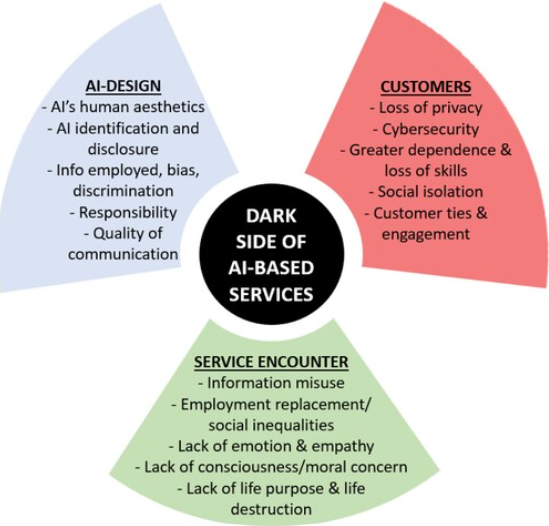
The dark side of AI isn't just about killer robots from movies (usually!). It's about real-world issues that can unintentionally or intentionally harm people if we're not careful. Here are some key ideas:
- AI Bias: AI systems learn from data. If the data used to train an AI is biased (e.g., mostly represents one group of people, or reflects historical discrimination), the AI will learn and repeat that bias. This can lead to unfair decisions in things like loan applications, job hiring, or even facial recognition.
- Privacy Concerns: AI often needs vast amounts of personal data to function. How is this data collected, stored, and used? There's a significant risk of privacy breaches, data misuse, and even surveillance if not handled with care.
- Job Displacement: As AI gets smarter, it can automate tasks previously done by humans. While this can increase efficiency, it can also lead to job losses in certain sectors, creating economic challenges.
- Misuse and Malicious Use: AI can be intentionally used for harmful purposes, such as creating convincing fake videos (known as deepfakes) to spread misinformation, developing autonomous weapons without human oversight, or facilitating cyberattacks.
- Lack of Transparency (The Black Box Problem): Sometimes, it's incredibly hard to understand why an AI made a particular decision. This "black box" nature makes it difficult to trust, audit, or even fix problems when an AI goes wrong, especially in critical applications like healthcare or justice.
Tips for Building Responsible AI
As a developer, you have the power to make AI a force for good. Here's how you can help prevent the dark side from taking over:
1. Mind Your Data
- Clean and Diverse Data: Always check your training data for bias. Ensure it's diverse and representative of all groups that will be affected by your AI. If you see bias, try to correct it or use techniques to mitigate its impact.
- Data Privacy by Design: Think about privacy from the very start. Collect only the data you need, anonymize it whenever possible, and secure it robustly. Follow data protection laws like GDPR.
2. Aim for Transparency
- Explainable AI (XAI): Try to build models that are easier to understand. If your AI makes a decision, can you explain why it made that decision? Tools and techniques are emerging to help with this.
- Clear Communication: Inform users about how your AI works, what data it collects, and what its limitations are.
3. Test for Fairness
- Bias Auditing: Don't just test for accuracy; test for fairness across different demographic groups. Are the results consistent for everyone, regardless of their gender, race, or age?
- User Feedback: Involve diverse user groups in testing and gather feedback to identify unintended biases or harmful outcomes.
4. Keep Humans in the Loop
- Human Oversight: For critical decisions, always have a human review the AI's output. AI should augment human intelligence, not replace it entirely without supervision.
Tools and Technologies for Ethical AI
You don't have to tackle these challenges alone! There are tools and frameworks designed to help you build more ethical and responsible AI:
- IBM AI Fairness 360: An open-source toolkit that helps detect and mitigate bias in machine learning models.
- Google's What-If Tool: A visual, interactive tool to understand machine learning models, inspect their performance, and explore fairness issues.
- Microsoft's Responsible AI Toolbox: Includes tools for fairness, interpretability, and privacy.
- Explainable AI (XAI) Frameworks: Libraries like LIME (Local Interpretable Model-agnostic Explanations) and SHAP (SHapley Additive exPlanations) help you understand model predictions.
Real-World Examples of AI Gone Wrong
- Biased Facial Recognition: Studies have shown that some facial recognition systems are less accurate at identifying women and people of color, leading to unfair arrests or misidentifications.
- Algorithmic Discrimination: AI used in hiring processes or loan approvals has sometimes been found to disadvantage certain groups due to biased training data.
- Deepfakes: Maliciously created videos or audio using AI to impersonate individuals, often for propaganda, blackmail, or harassment.
- Predictive Policing: AI systems that predict crime hotspots have sometimes reinforced existing biases, leading to over-policing in certain communities.
Common Mistakes to Avoid
- Ignoring Data Bias: Assuming your data is clean and unbiased without actually checking.
- Lack of Transparency: Building "black box" models for critical applications without any explanation.
- Not Testing for Fairness: Only focusing on overall accuracy and ignoring how the AI performs for different subgroups.
- Prioritizing Performance Over Ethics: Pushing for the highest accuracy or efficiency without considering the potential societal impact.
- Ignoring User Feedback: Not listening to users who report issues of unfairness or unintended harm caused by your AI.
Conclusion: Build AI for Good
Understanding the dark side of AI isn't meant to scare you; it's meant to empower you. By being aware of these challenges, you can develop AI systems that are not only innovative but also fair, transparent, and beneficial for everyone. The future of AI is in your hands!
Ready to make a difference? Explore projects focused on ethical AI, data privacy, and explainable AI on Projects Hub. Or, even better, start building your own responsible AI project today!