support@fypprojects.com +92 3085146420
AI-Enabled IoT System for Smart Surveillance and Security
Home AI AI-Enabled IoT System for Smart Surveillance and Security
AI ML Advanced New

AI-Enabled IoT System for Smart Surveillance and Security

22 2026-07-20T07:08:18.962354 26 tags

Quick Overview

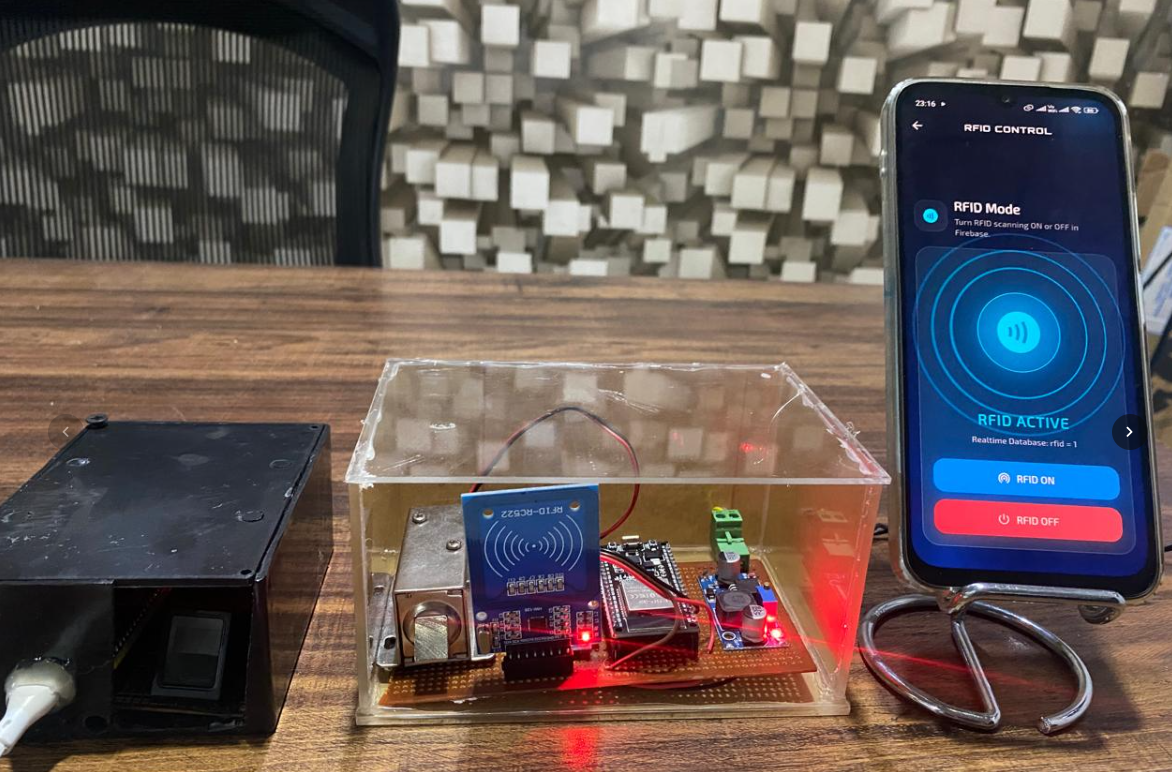
The AI-Enabled IoT System for Smart Surveillance and Security is a smart four-layer door-locking project designed to improve safety in homes, offices, laboratories, and other restricted areas. The system combines RFID card verification, password entry, fingerprint scanning, and face recognition before giving access. An ESP32 microcontroller controls the hardware, while Firebase stores and updates data in real time. A Flutter mobile application allows users to check the lock status, manage users, update passwords, and control the system remotely. This project brings together IoT, artificial intelligence, biometrics, cloud technology, and mobile development in one practical security solution.
Project Gallery

Click an image to preview above
#AI-Enabled IoT System#Smart Surveillance#Smart Security System#IoT Security#ESP32 Project#Smart Door Lock#Four-Layer Security#Multi-Factor Authentication#RFID Authentication#Password Security#Fingerprint Recognition#Face Recognition#AI Face Detection#Python Face Recognition#Firebase Integration#Flutter Mobile App#Cloud-Based Security#Biometric Security#Embedded Systems#Solenoid Lock#Remote Access Control#Real-Time Monitoring#Home Security#Office Security#Access Control System#Final Year Project

Project Details

Traditional door locks usually depend on one security method, such as a key, password, or access card. These methods can be unsafe because keys may be lost, passwords may be shared, and RFID cards may be copied. This project solves that problem by using four security checks instead of one. The first step is RFID verification. The user scans a registered RFID card, and the system checks whether the card is authorised. If the card is accepted, the user moves to the second step and enters a password. A wrong password stops the process and denies access. The third step is fingerprint verification. The fingerprint sensor compares the user’s fingerprint with stored records. Since fingerprints are unique, this adds a stronger level of identity checking. The final step is face recognition. A camera captures the user’s face, and a Python-based face recognition system compares it with saved images of authorised users. Only after all four checks are completed successfully does the ESP32 send a signal to the relay module. The relay activates the solenoid lock and opens the door. After a fixed time, the system locks the door again and returns to its waiting state. Firebase Realtime Database connects the hardware with the mobile application. It stores user details, passwords, access information, and the current lock status. Through the Flutter mobile app, an authorised person can add or remove users, change passwords, monitor the lock, view activity, and control access remotely. The system uses Python, Arduino IDE, Flutter, Firebase, Fritzing, Visual Studio Code, an ESP32 board, RFID reader, fingerprint sensor, camera, relay, buck converter, and solenoid lock. Testing showed that the system can perform user verification quickly and accurately. This project offers a modern, scalable, and user-friendly approach to security. By combining several authentication methods, it reduces the risk of unauthorised entry and provides stronger protection than traditional single-layer locks. It can be used in smart homes, offices, banks, laboratories, data rooms, and other places where controlled access is important.