support@fypprojects.com +92 3085146420
Arduino-Based Ultrasonic Distance Alarm System
Home AI Arduino-Based Ultrasonic Distance Alarm System
AI ML Beginner New

Arduino-Based Ultrasonic Distance Alarm System

44 2026-07-20T07:33:50.644008 10 tags

Quick Overview

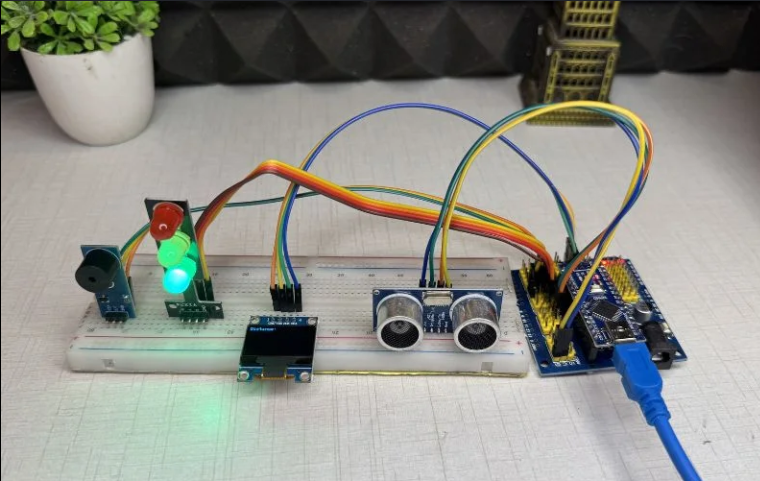
This project develops an Arduino-based distance alarm system using an HC-SR04 ultrasonic sensor. The system continuously measures the distance of nearby objects. Green, yellow, and red LEDs indicate safe, warning, and danger zones, while a buzzer sounds when an object is too close. The project demonstrates how sensors, LEDs, and buzzers can work together through Arduino programming.
Project Gallery

Click an image to preview above
#Arduino#Arduino Uno#HC-SR04#Ultrasonic Sensor#Distance Alarm System#Distance Measurement#Obstacle Detection#Embedded Systems#Buzzer Alarm#Tinkercad

Project Details

The Arduino-Based Ultrasonic Distance Alarm System is designed to detect the distance between the sensor and nearby objects using ultrasonic technology. The system is built around an Arduino Uno microcontroller, which controls all the connected components. An HC-SR04 ultrasonic sensor continuously sends ultrasonic sound waves and measures the time taken for the echo to return after hitting an object. Using this time, the Arduino calculates the distance between the sensor and the object. Based on the measured distance, the Arduino controls three LEDs and a buzzer to provide visual and audible alerts. When the object is more than 20 cm away, the green LED turns on, indicating a safe distance. If the object comes within 10 to 20 cm, the yellow LED lights up to indicate a warning. When the object is less than 10 cm away, the red LED turns on and the buzzer sounds, warning the user that the object is very close. The sensor continuously repeats this process, allowing the system to monitor distance in real time. The project is simple, cost-effective, and easy to assemble using commonly available electronic components such as an Arduino Uno, HC-SR04 ultrasonic sensor, LEDs, resistors, a buzzer, a breadboard, and jumper wires. It demonstrates the practical use of sensors, microcontrollers, and programming in embedded systems while helping students understand how real-time monitoring and automation work. This project has several practical applications, including car parking assistance, robot obstacle detection, security alarm systems, industrial automation, and distance monitoring. Although the system performs well for short-range object detection, its accuracy can be affected by soft or irregular surfaces that absorb sound waves. Future improvements may include adding an LCD display to show the measured distance, Bluetooth or Wi-Fi connectivity for remote monitoring, or integrating the system with IoT platforms for smart automation and data logging.